 在场
在场Same: Same
My fascination with jazz started with a story about fake books. The first time I heard the phrase “fake book,” the image that popped into my head was a book whose cover says, “Don’t look, it’s fake.” Later I learned it was something completely different.
Its “fake” does not mean counterfeit. It means pretending. You can think of a fake book as a lifesaving crib sheet. It usually is not a full score, but a single melody line plus chord symbols, sometimes with lyrics. The purpose is almost embarrassingly practical. Tonight you are playing a regular gig in a bar, a dance hall, or a restaurant. The audience requests songs the way they order dishes, and they do it with an impressive level of confidence. You cannot possibly memorize everything, and you cannot haul a cart of sheet music everywhere you go. So what do you do. You bring a fake book. You flip to the tune. The melody and the harmonic skeleton are there. The rest is on you.
The background of how it came to be is genuinely fun. In the 1920s, a major part of the American music business was sheet music publishing, and the popular music of that era was later grouped under what people call the Great American Songbook. The order of things was almost the reverse of today. Now the usual story is that a song becomes popular as a film theme or through performance, and then it gets recorded, circulated, and purchased. Back then, a large portion of popular songs traveled through sheet music, publishing, and performance first. They later became part of that standard tune tradition, and only then were they sung into wider fame in films or live venues. So musicians had to buy sheet music if they wanted to play.
But there were several problems. As time went on, those “standards” kept piling up. Before the internet, musicians had a hard time getting the scores. Musicians were also poor. They could not afford expensive sheet music, and they could not carry that much paper around with them. The music itself was often lush and ornate. Even if a musician bought the score, a small five person band could not really use it. They could not reproduce what was written, so buying it was not very helpful. Finally, there was no easy way to search through this ocean of repertoire. A lot of music happened on the street. Live playing and improvisation were in huge demand, and nobody could supply it efficiently.
In that context, a man named George Goodwin came up with a tool called Tune Dex. It started as an index card system for radio. Each card was about the size of a library card, and it held only the basic melody, the hook, and the lyrics. A musician could glance at it and the song would come back to them. It was not a full score. It was a lead sheet. How the piano voiced the harmony, how the bass walked, what the drummer did with the groove, who counted off the intro, who shaped the ending, none of that was prescribed. You had to rely on experience, your ear, and what you could do in the moment to let it grow into an actual performance. As soon as Tune Dex appeared, it became a hit. People began to reassemble, photocopy, and reformat materials in this style into booklets, because it solved a massive productivity problem for working musicians. Even if a small band could not deliver the grandeur of a huge orchestra, it could at least stumble through a tune in a sparse, imperfect way. The crowd would have something to listen to, something to sing, and that was enough. That is why people called those compilations bootleg fake books, meaning: here is the skeleton, now you make it into a song. And “fake” in classical music is a complicated idea. It is like lip syncing. You have not practiced, you cannot really sing, but you move your mouth and blend into the choir as if you are singing.
And of course, fake books were pirated and illegal. Once these little cards and their compiled descendants spread among musicians, people rushed to copy them and duplicate them, and countless errors appeared in the process. The most classic one is that for a long time people thought Blue Train was called Blue Trane, as if it were a tribute to the great John Coltrane. Some say it was a careless misprint. Some say it was a deliberate pun. But once it enters a chain of reproduction, an error grows its own legitimacy.
This kind of blatant piracy naturally attracted the attention of the FBI, and the result of their investigation is also oddly amusing. In 1964, the FBI’s Cleveland office wrote a line in a file that sounds almost exaggerated. Roughly: almost every professional musician owned at least one of these fake books, because they might be among the most useful reference tools a working musician could have. Well then. Bad money drives out good.
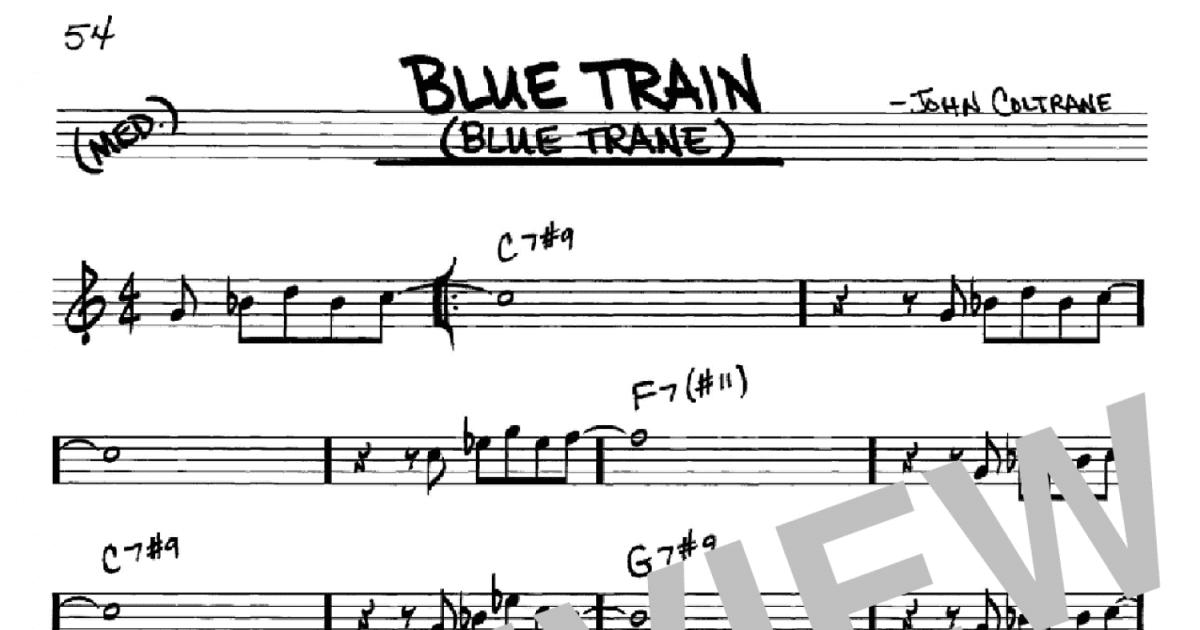
Later the most legendary version appeared. In the 1970s, students at Berklee College of Music put together what became The Real Book. It was essentially another fake book, just better made and more aligned with the jazz repertoire of its time, so it quickly became a kind of holy text inside the scene. The problem was that it was still pirated. It was printed at copy shops, passed around through acquaintances, coded signals, and the kind of distribution where someone pulls it out of a trunk. Later, publishers negotiated rights one tune at a time, and around 2004 a more official legal version appeared, namely The Real Book 6th Edition.
This is where it starts to get interesting.
Imagine that the musical world originally had “complete files,” like full big band scores. Extremely high information density. Beautiful, rigorous, and expensive. Then the fake book did something bold. It compressed the “complete” into a “skeleton.” It kept only the most structural parts, the melody and the harmonic frame, and handed everything else to the performer to fill in. After that, artists took these classic, sometimes decaying musical frameworks and, with their own technique and musical instincts, developed them into jazz standards that belonged to them.
A kind of positive magic happened here. The compression was not laziness. It allowed music to move. You take the same skeleton, and different musicians on different nights in different moods can develop it into something completely different. It is like feeding Chu Shi Biao, The Memorial to the Emperor, into Google Translate, translating it into Japanese, then translating it back into Chinese. The result will of course be different, but difference is not necessarily a flaw. Difference can be a form of creation.
And the same process, concrete to abstract to concrete, does not always produce greatness that surpasses its source the way jazz sometimes does.
I still remember that experience at the Chalmers cafeteria. My friends watched the cook take out trays of uniformly shaped meatballs or pork cutlets from a heated cabinet, pair them with mashed potatoes and gravy, plate everything quickly, and produce a complete lunch in minutes. The expressions on their faces shifted rapidly from shock, to disdain, to delight. They said, hey, isn’t this also pre made food.
Then we saw the assembly line at McDonald’s and Burger King. The fries were frozen from suppliers. The buns were ready made. Some people got even more excited, like they had suddenly found a handle to grab. They nodded and said, see, it’s all the same. Sweden does pre made food too, and it sells it for more.
And that is not exactly wrong. Just like you can say psychedelic rock and hardcore are both rock, therefore they are the same, even though fans from both sides might come and hit you for it. But what happens next is the key. If you stop there, you get a joke, or a highly compressed, distorted “fact.” But if you treat that compression as the foundation for deeper discussion, the foundation is obviously shaky and full of holes. That summary becomes a way to steal differences, and to steal the responsibilities and consequences that come with those differences.
In the Chinese context, a large part of why pre made food gets condemned so harshly is not industrialization itself, but the emergence of “microwave kitchens” that literally do not even have a pan, plus excessive preservatives and the broader fear and distrust around additives. Nobody questions speed. People question whether it is any good. In that sense, yes, you can call it the same kind of thing as a Swedish cafeteria or McDonald’s. But the starting point is different. One is, under a promise of hygiene, trading taste for speed. In the extreme cases I have seen, the other feels more like, under a promise of efficiency, trading everything that can be traded for low cost. And then, in the middle of that discussion, someone will ask: if they are different, where is the boundary. If a barbecue place uses frozen skewers from the supermarket, does that count. If the barbecue place marinates meat and threads skewers the day before, does that count. If I prep ingredients at home half an hour in advance, does that count. Watching a whole chain of continuum fallacy tricks quickly sour the conversation, you just want the argument to end, otherwise my life also becomes pre made food, since my today was planned yesterday. And the person who remains in the debate arena to the very end becomes the unquestioned winner, contentedly collecting a fresh “win.”
And compared with this kind of conceptual conflation and false equivalence, the later moves, the whataboutism and the selective comparisons capped with a self proclaimed victory, look even uglier. For example, the first thing my friend said after pulling the Swedish cafeteria into the pre made food camp was: pre made food sells so expensive here, it is worse than back home, at least it is cheap there. After going through all those hoops just to “elevate” the discussion to money, my friend clearly lacks ambition. I imagine that the true master of this craft, Lei Jun of Xiaomi, could surely find even more devious angles to make Chinese pre made food win, win, and win again.
This “same, same” also happens with more abstract words, like capital, the system, political correctness. It even happens inside slogans that look like the most correct ones. “Everyone is equal” is a beautiful sentence, but what exactly is it saying. Equal in dignity. Equal before the law. Or equal in ability and outcomes. If you do not force it to land, if you do not break it open, it becomes a master key that can open every door and also lock every discussion. You can use it to demand that the world run like a fairy tale. You can also use it to erase real differences that exist in reality, then turn around and accuse anyone who points out differences of lacking compassion.
A fake book is at least honest. It never pretends to be a full score. It says: this is what I am, now go wild. For a long time, I loved to say “to put it plainly.” Later I realized it was a form of impatience, forcing the other person to store a complex idea in my preferred shape. And for many people, “to put it plainly” looks more like the Cultural Revolution style of reading, seeing Chiang Kai Shek’s face and dozens of counterrevolutionary slogans in the texture of a Golden Leaf cigarette package, full of subjectivity and label slapping. You think you are discussing facts, but you might only be keeping time with a few big words, without ever hearing the chords.