 在场
在场Lao Yang and I
It’s been a month since I arrived in Sweden. Yesterday, while at the shooting club, I suddenly missed Lao Yang — my dad.
When I was little, I loved shooting games. It’s probably a boy thing. My mom thought it was dangerous, so Lao Yang would secretly take me to the children’s park to play. When he saw I couldn’t win a prize, he’d step in and try himself. If he failed too, our only consolation was going together to eat cheap starch sausages from a street vendor. Buying flowers and carrying wine are the carefree matters of youth; today, the mood is simply not the same.
Lao Yang was the first college student to ever come out of his village. I only found this out when I grew up.
My grandma’s house was over 500 kilometers away from Changchun, my hometown. When I was a kid, taking the slow “green train” (the lowest speed train) back for Chinese New Year meant changing transportation three times. Later, when we bought a car, it still took over six hours to drive. I remember our car was always filled with relatives I barely knew on those round trips. They were either visiting friends and family or coming to Changchun to see a doctor. Lao Yang never said no to their requests for a ride, even if I was squeezed awkwardly in the back seat; he’d just tell me to bear with it. Later on, these unfamiliar relatives would often stay at our house. Some just crashed for a night before catching a train the next day, some had medical appointments, and others stayed long-term because hospital wards were too expensive.
The relatives always brought something when they came—either a free-range chicken they raised or tomatoes from their garden. Lao Yang would always take charge of the kitchen, whipping up a table full of good food, drinking a few glasses of liquor with them, and shuttling them back and forth between hospitals and train stations. My mom has a very sharp tongue, but Lao Yang never talked back when she complained about this. Later, I heard stories about Lao Yang from these relatives: starting in middle school, he walked thirty li (about 15 kilometers) to town every day for school, and had to help collect manure and chop firewood when he got home. Later, he got into a boarding high school in the county, and finally made it to college in Changchun. Their stories always ended with the same phrase in our local dialect: “Lao San (the third son) is really something else.”
I once asked him, “You walked home every day and then did chores, did you even have time to study at night?” Lao Yang said he memorized textbooks on the walk because there was nothing else to do. If he couldn’t memorize it, he’d pull the book out of his bag and read. After finishing Chinese, he’d read Russian. He could read the whole way. The kids who had bicycles couldn’t read while riding, and none of them ended up passing the college entrance exams. He looked a bit proud when he said this. I asked him what his strongest memory from that time was. He thought about it for a long time and said, “Hunger.” He said he couldn’t even focus in class because all he thought about was food. Then he told me stories about sneaking into the production team’s fields to steal vegetables, potatoes, and corn. He made it sound so appetizing that I begged him to go buy me potato chips and popcorn.
Lao Yang doesn’t like gathering a big crowd of friends. In his younger years, he had a great capacity for alcohol but never lingered at drinking parties. Later, he fell in love with playing badminton, but he only ever had one badminton partner. When that partner moved to Beijing to be with his son, Lao Yang’s hobby ended too. My mom joked that he was just “pulling wool from the same sheep.” He simply said socializing was too tiring; if you have someone you click with, why change? Eventually, after he trained my mom to be his new partner, she started setting up matches with her colleagues, so he hung up his racket and rested again.
Lao Yang is incredibly loyal to his friends. Once, an old classmate who ran a private school asked him to help teach a communications class for a year, and he gladly agreed. I only found out because I came home and saw him wearing his reading glasses late at night, researching materials. I asked him, “How much are they paying you?” He said, “What does money have to do with it? I’m just doing a favor. I’ll teach it as best as I can.” After a year of burning the midnight oil writing lesson plans and grading homework, I asked him, “Are you going back next year?” He said, “Too tiring. Not going.” I asked, “Then why did you agree to it in the first place?” He thought for a long time and said, “Ah, if you can help, you help.” Yeah. If you can help, you help.
Lao Yang is stubbornly principled. He doesn’t like to lose his temper; he just bottles everything up. I can only remember him losing his temper once. It was because my second uncle got drunk at a Chinese New Year dinner and disrespected my grandma (maternal). Lao Yang chewed him out right then and there and kicked him out. Afterwards, my mom complained, asking why he had to blow up like that while eating at her family’s house. Lao Yang held his tongue for a while before saying, “Disrespecting the old lady is just unacceptable.” I chimed in and said, “Right! I wanted to hit him myself.” My mom just sighed and said we father and son shared the same stinky temper. My second uncle never went to my grandma’s house again after that, but my maternal uncle started coming over often to drink with Lao Yang.
Lao Yang and I also rely almost entirely on unspoken understandings to express ourselves. His first step in waking me up was opening my bedroom door. If he made breakfast and I still wasn’t up, he’d wander into my room and make the floorboards creak. Next, he’d play the radio in the living room. If all else failed, he’d tickle the soles of my feet, fully executing a gentle, tiered awakening strategy. When I started working and came home late, he would always leave the porch light on for me before going to bed. When I told him I was going to study in Sweden, the next day he spent ages talking to me about his own impressions of Sweden from back in the day, sharing all the local environmental, historical, and cultural info he had gathered. He finished by saying, “It’s your decision.” My mom always secretly tells me that Lao Yang doesn’t understand romance, but I notice that her jewelry box gets new additions every year, and the clothes and bags in her closet are steadily updated. Maybe I don’t understand Lao Yang, just as Lao Yang might not understand my mom.
In my memory, Lao Yang truly started aging after my grandma passed away. The first year Lao Yang bought a car and drove back to Grandma’s, he started buying fireworks. He said you couldn’t buy ones this big in the village, and he wanted Grandma to see them. Then he’d drag me around supermarkets and malls, stuffing the trunk full. When we got home, he’d show Grandma everything one by one, letting her taste and see all the novelties. He was always the one driving when we went back for New Year’s, even after I got my driver’s license—he wouldn’t let me drive. Lao Yang bought a DSLR camera back when I was in elementary school, but he only ever used it to take pictures of Grandma and our relatives in the village. Once, we drove far away to visit a relative. He told me to take a picture of them together. When he went home next, he held his laptop and pointed at the screen for Grandma: “This is so-and-so, that is so-and-so. They are all doing well, but they couldn’t come to see you.” After Grandma injured her leg, he frequently drove back to the hometown, contacting doctors, agonizing over whether she should have surgery, and staying awake night after night. Fortunately, her condition improved, but she could never leave her wheelchair again.
After Grandma passed away, Lao Yang made a rare post on his WeChat Moments. After that, he stopped dyeing his hair and stopped going back to Grandma’s house for Chinese New Year. He said, “That’s your second uncle’s house now. They have a big family of their own. It’s not right to go to someone else’s house for the New Year.” In the first lunar month of the year before last, I went back to the village with him once. Fewer people called him “Lao San” anymore; instead, there were young men calling him “Youngest Uncle” and kids calling him “Grandpa.” Lao Yang just responded with a smile. He didn’t drive anymore; he told me to drive.
Lao Yang is now quietly waiting to retire. He says it’ll be nice to step down, that he doesn’t want to attend those pointless meetings or write those reports anymore. I said, “Then just don’t go. Spend more time traveling and having fun with Mom.” He took a sip of tea and said, “That would make it hard for the leadership to manage. I go in the morning and come back at noon, that works well for everyone.” My mom called him stubborn. Lao Yang just read his book and didn’t say a word. But he still makes breakfast for my mom at six-something every morning before riding his bike to work. I told him, “Let me buy you a small courtyard house in Jingyue. You can grow vegetables, cool off, and read in the summer, and watch the snow in the winter.” He said, “I’m sick of farming. Not going.” I asked, “Then what do you want to do?” He thought for a long time and didn’t have an answer. I think Lao Yang will just keep reading and riding his bike. He might continue tinkering with his piles of programming code, or go to the electronics market to buy parts to build weird contraptions for the house. Being content in his own world isn’t so bad either.
They say a son’s personality grows more and more like his father’s. I used to think Lao Yang lived too exhausting a life, and I didn’t want that for myself. But now I think… maybe it’s not so bad.
I hope Lao Yang is doing well.
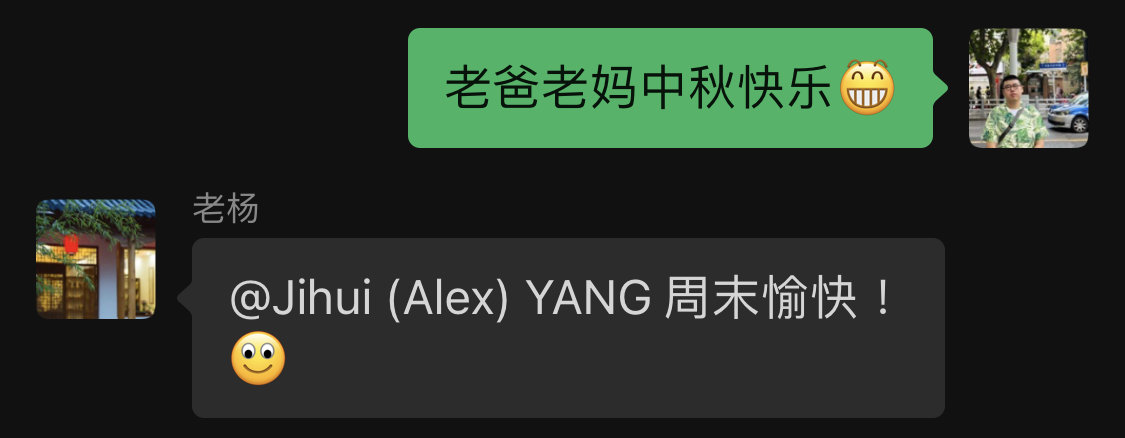
Written on 2023.09.30